For many fulfillment operations, packaging is one of the last manual processes left on the floor.
Even in facilities that have modernized other parts of the workflow, pack areas often still rely on pallets of pre-made boxes, manual forming, and void fill to handle order variability. These processes may be inefficient, but they are deeply familiar — and familiarity creates a sense of operational safety.
If demand spikes or something goes wrong, teams know they can fall back on the same approach: order more boxes, add more labor, and keep shipments moving. The status quo may not be optimal, but it is predictable.
This is why packaging automation can feel risky at first. Not because the technology is difficult to operate, but because it challenges a process that has “always worked,” even if it has never worked particularly well.
The Comfort and Cost of Box Inventory
Walk into a typical batch packing area and the challenge becomes clear.
Packers often work from staging zones surrounded by pallets of box inventory. Each pallet represents a decision made weeks or months earlier — a forecast of what order demand might look like. When reality doesn’t match that forecast, packers compensate.
They choose the closest box size. They add more void fill. They spend extra time forming, taping, and adjusting packaging to fit the shipment.
Over time, these workarounds become normalized. Oversized packaging, material waste, and congested pack areas are treated as unavoidable parts of shipping.
But the real issue isn’t just packaging cost. It’s operational complexity.
Managing dozens of box SKUs requires space, replenishment, forecasting, and material handling. Variability in orders creates variability in packing speed. Labor requirements fluctuate. Freight costs increase due to dimensional weight inefficiencies.
These challenges are rarely tied back to a single root cause. Instead, they show up as friction across the entire fulfillment workflow.
Automation Designed for Real Operations
Modern packaging automation is built specifically to address these realities.
Today’s systems are hardened for continuous production use. They are designed to be operated by standard warehouse personnel, not specialized technicians. Training requirements are minimal, and support structures are in place to help teams maintain uptime and performance.
For many organizations, introducing packaging automation is not about transforming the entire facility overnight. It is about bringing structure and consistency to one of the most variable and labor-intensive parts of the shipping process.
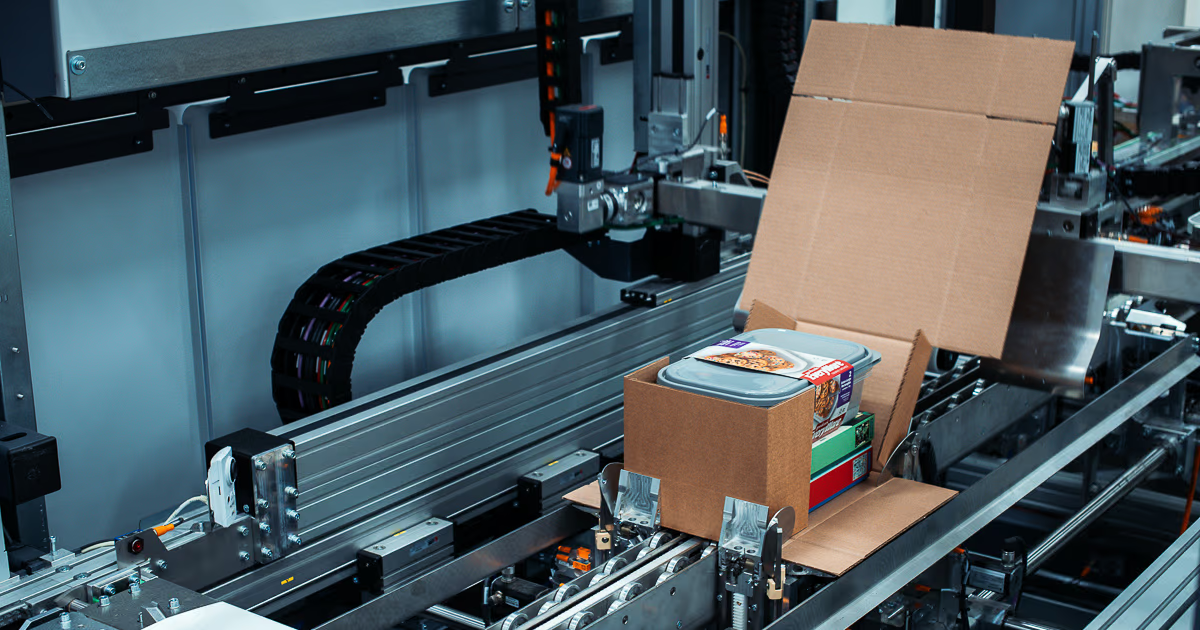
Rather than selecting from pre-made packaging options, teams can produce right-sized boxes on demand — based on the actual order in front of them.
This shift reduces decision-making on the pack floor and simplifies workflows. Instead of adapting shipments to fit available packaging, packaging adapts to fit the shipment.
What Changes When Packaging Becomes On Demand
When packaging is produced as needed, the physical and operational environment of the pack area begins to change.
Before:
- Pallets stacked with multiple box sizes
- Manual forming and taping
- Frequent replenishment runs
- Variable packing speeds
- Significant void fill usage
After:
- On-demand box production aligned with order flow
- Reduced packaging storage requirements
- More consistent packing processes
- Improved material utilization
- Simplified labor planning
These changes can translate into measurable improvements in throughput, freight efficiency, material consumption, and workspace organization.
Just as importantly, they help teams manage variability more effectively — without relying on constant manual adjustments.
A Practical First Step Into Automation
Organizations that already operate automated storage, sortation, or robotics systems often evaluate packaging automation as another logical process improvement.
For operations earlier in their automation journey, packaging can be one of the most approachable places to start.
It typically requires less facility redesign than other forms of automation. It delivers visible operational improvements quickly. And it addresses challenges that teams are already working hard to manage every day.
Automation in packaging is not about introducing complexity. It is about reducing the hidden complexity that manual processes create.
In that sense, adopting packaging automation is rarely a leap into the unknown. More often, it is a practical step toward building a more scalable, resilient fulfillment operation.
Because the real challenge isn’t that packaging automation is difficult. It’s that for a long time, packaging has simply been done the hard way.